Tony Hobson
Biography
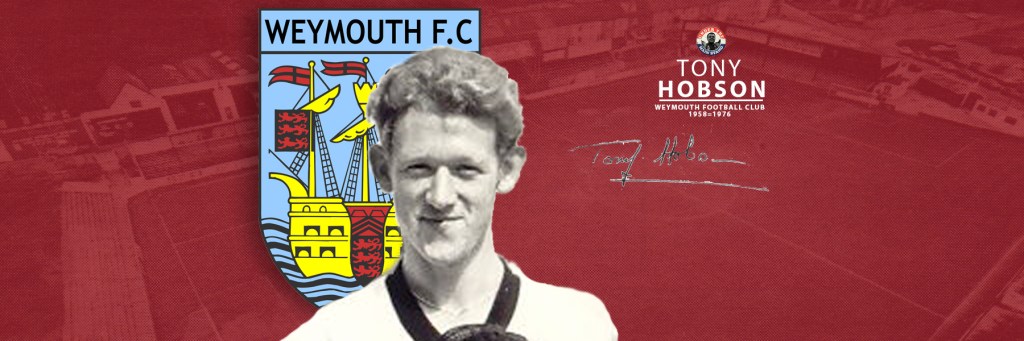
Few footballers are as closely associated with one club as Tony Hobson is with Weymouth. A locally born player who progressed from youth football to become captain, defensive mainstay and record appearance-maker, Hobson represented the Terras for 18 seasons between 1958 and 1976. His career encompassed championship triumphs, historic FA Cup matches and hundreds of appearances at the heart of the Weymouth side. Long after his final game, he remains one of the most important figures in the club’s history.
Early life and footballing family
Tony Hobson was born in Weymouth on 20 February 1940. His connection with Weymouth Football Club was inherited as well as forged through his own achievements. His father, Tony Francis Mowbray Hobson, had been a prolific Weymouth player during the 1930s and 1940s, making more than 200 appearances and scoring more than 200 goals for the club.
The younger Hobson began playing locally with Weymouth YMCA. He joined Weymouth FC in July 1958, initially captaining the club’s youth side before earning an opportunity in the senior team. He made his first-team debut on 8 October 1958, when Weymouth defeated local rivals Poole Town 5–1.
That appearance began an extraordinary association with the first team that continued until May 1976.
From forward to commanding defender
Hobson began his senior career as a forward and displayed a useful eye for goal during his early seasons. His most productive campaign came in 1960–61, when he scored seven times in all competitions. As his career developed, however, he was converted into a defender and became best known as a centre-half.
Contemporary reports depict him as a composed and dependable central defender. A report from Weymouth’s match against Nuneaton Borough in April 1968 described the tall, fair-haired Hobson as the outstanding player, repeatedly breaking up opposition attacks with controlled defensive play. That match was also reported to be his 180th consecutive appearance, illustrating the durability that became one of the defining features of his career.
Hobson’s adaptability was not limited to playing in attack and defence. He also appeared in goal on two occasions. The more notable instance came during Weymouth’s 1961–62 FA Cup campaign, when he took over from goalkeeper Bob Charles during the first-round victory over Barnet.
The historic 1961–62 FA Cup run
Hobson was an important member of the Weymouth team that produced one of the greatest FA Cup runs in the club’s history during the 1961–62 season.
The Terras began by defeating Dorchester Town 2–0 in the fourth qualifying round. They then beat Barnet, Newport County and Morecambe by the same 1–0 scoreline, progressing to the fourth round proper for the first time.
Weymouth’s reward was an away tie against Preston North End, then a Football League Second Division club with a distinguished history. The original match at Deepdale was abandoned because of dense fog. When the teams met again, Preston won 2–0, bringing Weymouth’s remarkable campaign to an end.
The run placed the club in the national spotlight and remains Weymouth’s joint-best performance in the FA Cup. Hobson made seven FA Cup appearances during that season and would eventually establish a club record for appearances in the competition.
Southern League champions
Weymouth were one of the leading non-League clubs of the era, and Hobson was central to their greatest period of sustained league success.
The Terras won the Southern League championship in 1964–65. Hobson made 25 league appearances during the campaign and also featured in the side that reached the Southern League Cup final, where Weymouth finished as runners-up.
The club retained its league title in 1965–66, with Hobson playing 43 league matches and 67 games in all competitions. Winning consecutive Southern League championships was an exceptional achievement. At the time, the Southern League contained many of the strongest clubs outside the Football League, and automatic promotion into the League did not yet exist.
Hobson also helped Weymouth finish third in the Southern League in 1959–60, 1962–63 and 1966–67. His career therefore covered not just two championship seasons but a lengthy period in which the Terras were consistently among the leading teams in non-League football.
Captain and club record-holder
Hobson’s longevity was matched by the responsibility entrusted to him. He captained Weymouth on a reported 449 occasions—a club record—and became the youngest player to reach 200 appearances for the Terras. He achieved that milestone on 2 November 1963 at the age of 23.
He also holds the Weymouth record for the most FA Cup appearances, with 57. His overall playing record is expressed differently in surviving club sources because the totals do not always include the same combinations of league, cup, minor cup, representative and friendly matches.
The detailed senior competitive record credits Hobson with 938 appearances, including five as a substitute, and 32 goals. This total comprises 631 Southern League appearances, 56 FA Cup appearances, 75 Southern League Cup appearances and 176 matches in other competitions. Some Weymouth historical accounts list 933 appearances, reflecting small differences in the treatment of particular games, while the widely quoted total of 1,076 includes additional first-team fixtures such as friendlies.
Whichever method is used, Hobson stands as Weymouth’s record appearance-maker. The scale of that achievement is remarkable: he was a regular first-team player across 18 seasons, often playing more than 50 matches in a campaign.
Later cup success
Although Weymouth’s consecutive league championships were the outstanding team honours of Hobson’s career, success continued into the 1970s.
The Terras reached the Southern League Cup final in 1970–71, losing in the final, before winning the competition in 1972–73. Hobson played throughout that successful campaign and scored in the competition.
The following season, Weymouth reached the quarter-finals of the FA Trophy. Introduced in 1969, the Trophy had quickly become the leading national cup competition for senior non-League clubs. The 1973–74 run represented another notable achievement during the latter stages of Hobson’s career.
Even as he entered his mid-thirties, Hobson remained an exceptionally regular presence. He made more than 60 appearances in all competitions in each of his final two seasons. During 1975–76, his last campaign with Weymouth, he played 65 times and scored twice.
His association with the first team ended in May 1976, when he was released after nearly two decades of service.
Career after Weymouth
Hobson remained active in local football after leaving the Terras. He joined Bridport in 1976 and spent three seasons with the club. His time there included success in the Western League Cup and Dorset Senior Cup, while his individual contribution was recognised when he was named Bridport’s Player of the Year in 1979.
He subsequently joined Portesham United in 1979 and moved to Portland United in 1981.
In 1982, Hobson returned to Weymouth in a managerial capacity when he was appointed manager of the reserve team. He remained in the position until January 1984. After leaving the role, he returned to Portland United for another spell, bringing his long playing career to a close at Grove Corner.
Cricket career
Hobson was also an accomplished cricketer. He played regularly for Weymouth as a wicketkeeper-batsman and was named the cricket club’s Player of the Year during the 1960s. In 1976—the same year that his Weymouth football career ended—he made his debut for Dorset.
His success in two sports underlines both his natural athletic ability and the place he occupied in Weymouth’s sporting life. He was not simply a footballer recruited to represent the town; he was a local sportsman whose career was deeply rooted in the community.
Recognition and legacy
In 2019, Hobson was one of the first eleven figures inducted into the Weymouth Football Club Hall of Fame. He entered alongside other celebrated names from the club’s history, including John Clarke, Willie Gibson, Martyn Harrison, Ian Hutchinson, David Laws, Bob Lucas, Jason Matthews and Graham Roberts.
A still more visible tribute followed in December 2022, when the Southill Stand at the Bob Lucas Stadium was renamed the Tony Hobson Stand. The name remains part of the stadium today.
Hobson’s legacy rests partly on the extraordinary size of his appearance total, but statistics alone do not fully explain his importance. He was a home-grown player, the son of a former Terra, who developed from a young forward into a commanding defender. He represented the club during one of its finest FA Cup campaigns, helped it win consecutive Southern League championships, lifted the Southern League Cup and served as captain hundreds of times.
Across 18 seasons, numerous managers and changing groups of teammates, Hobson remained a constant presence. His durability, versatility and loyalty made him one of the defining Weymouth players of the post-war era.
For generations of Terras supporters, Tony Hobson represents the ideal of the one-club stalwart: a local player who grew with the team, led it through some of its greatest seasons and accumulated a record that may never be surpassed. The stand bearing his name is therefore more than a personal tribute. It commemorates a career woven into the history and identity of Weymouth Football Club.